Curriculum
-
-
Ultimate Robotics Programming with ROS 2 and Python Free preview
-
-
-
(Included in full purchase)
Introduction
-
(Included in full purchase)
-
-
(Included in full purchase)
Introduction to Robot Operating System 2
-
(Included in full purchase)
Introduction to Robot Operating System 2
-
(Included in full purchase)
-
-
(Included in full purchase)
Hands-on ROS 2 Programming Using Python
-
(Included in full purchase)
Hands-on ROS 2 Programming Using Python
-
(Included in full purchase)
-
-
(Included in full purchase)
Supplementary Tools for ROS 2
-
(Included in full purchase)
Supplementary Tools for ROS 2
-
(Included in full purchase)
-
-
(Included in full purchase)
Robot Visualization and Simulation
-
(Included in full purchase)
Robot Visualization and Simulation
-
(Included in full purchase)
-
-
(Included in full purchase)
Writing Tests Using Pytest for ROS 2 Nodes
-
(Included in full purchase)
Writing Tests Using Pytest for ROS 2 Nodes
-
(Included in full purchase)
-
-
(Included in full purchase)
Controlling an Inverted Pendulum with a PID Controller
-
(Included in full purchase)
Controlling an Inverted Pendulum with a PID Controller
-
(Included in full purchase)
-
-
(Included in full purchase)
Laser-based Obstacle Avoidance with a Wheeled Mobile Robot
-
(Included in full purchase)
Laser-based Obstacle Avoidance with a Wheeled Mobile Robot
-
(Included in full purchase)
-
-
(Included in full purchase)
ROS 2 Behaviour Trees Using Python
-
(Included in full purchase)
ROS 2 Behaviour Trees Using Python
-
(Included in full purchase)
-
-
(Included in full purchase)
Surveillance System Using Behaviour Trees
-
(Included in full purchase)
Surveillance System Using Behaviour Trees
-
(Included in full purchase)
-
-
(Included in full purchase)
Robot Navigation Using ROS 2 Navigation Stack (Nav2)
-
(Included in full purchase)
Robot Navigation Using ROS 2 Navigation Stack (Nav2)
-
(Included in full purchase)
-
-
(Included in full purchase)
Robot Arm Control Using MoveIt 2
-
(Included in full purchase)
Robot Arm Control Using MoveIt 2
-
(Included in full purchase)
-
-
(Included in full purchase)
Programming Aerial Robots Using ROS 2
-
(Included in full purchase)
Programming Aerial Robots Using ROS 2
-
(Included in full purchase)
-
-
(Included in full purchase)
Computer Vision Using ROS
-
(Included in full purchase)
Computer Vision Using ROS
-
(Included in full purchase)
-
-
(Included in full purchase)
Object Detection Using ROS 2
-
(Included in full purchase)
Object Detection Using ROS 2
-
(Included in full purchase)
-
-
(Included in full purchase)
Using Large Language Models with ROS 2
-
(Included in full purchase)
Using Large Language Models with ROS 2
-
(Included in full purchase)
-
-
(Included in full purchase)
Deep Reinforcement Learning Using ROS 2
-
(Included in full purchase)
Deep Reinforcement Learning Using ROS 2
-
(Included in full purchase)
-
-
(Included in full purchase)
INDEX
-
(Included in full purchase)
About the course
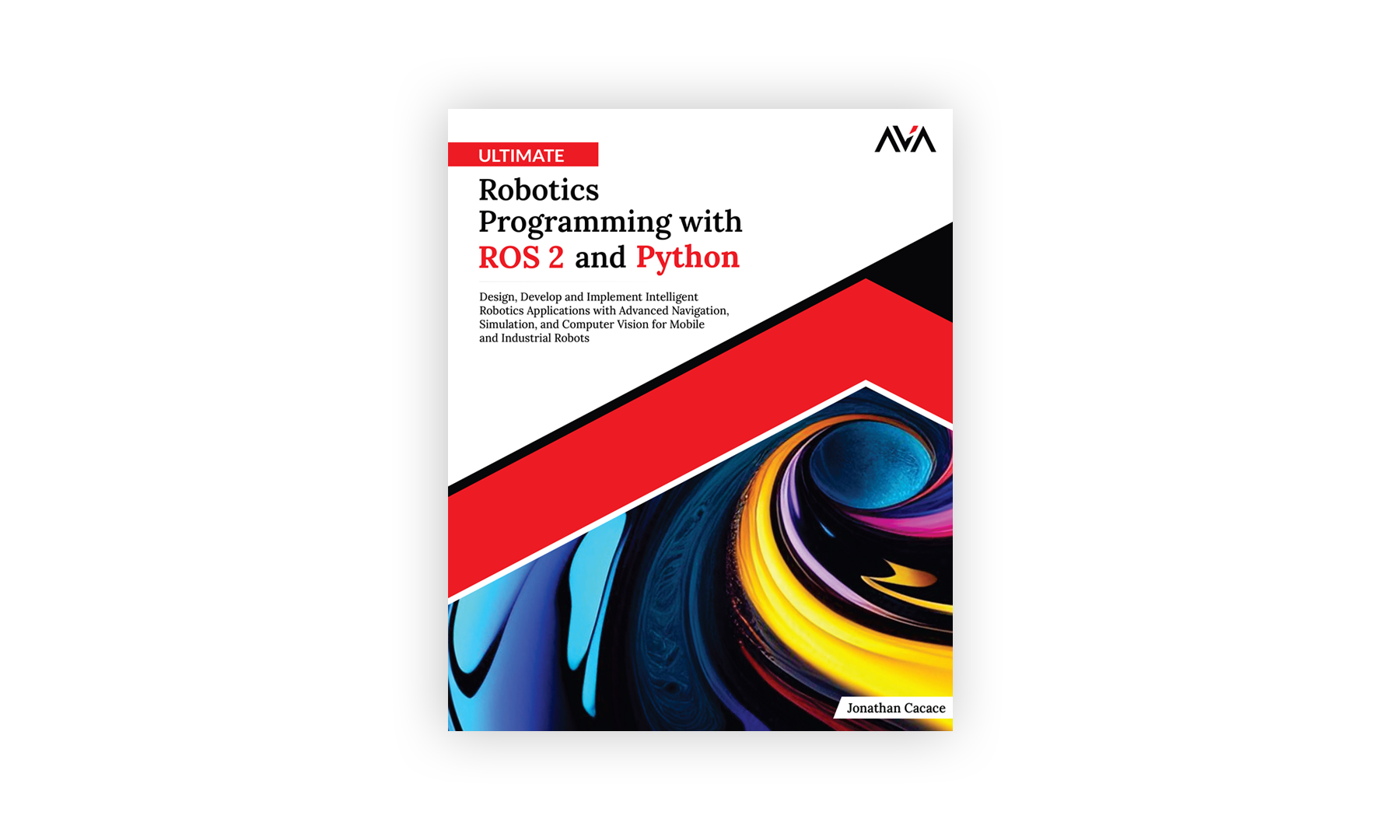
Robot Operating System (ROS) and Python are essential tools for developing advanced robotics applications, offering reliability and scalability for both research and industrial solutions. [Ultimate Robotics Programming with ROS 2 and Python] introduces readers to ROS 2 without requiring prior experience in robotics. It blends theoretical explanations with practical exercises, empowering readers to solve specific robotics problems while understanding the reasoning behind various approaches. The book covers a broad spectrum of robotics topics, including mobile robots, industrial manipulators, and aerial robots. These systems are simulated using the modern Gazebo simulator and programmed with ROS 2’s out-of-the-box tools and custom solutions using the ROS 2 API. The book also delves into computer vision, generative AI, and machine learning, providing hands-on examples of real-world applications. With intermediate challenges designed to reinforce learning, this book serves as an all-encompassing guide for anyone looking to master robotics programming with ROS 2 and Python. Step into the future of robotics and gain the expertise to build sophisticated, real-world robotic systems that can tackle the complex challenges of tomorrow.

About the Author
Jonathan Cacace was born in Naples, Italy, on 13 December 1987. He holds a Bachelor’s and Master’s of Science in Computer Science from University of Naples “Federico II”. Later he joined the PhD program of the same institution, earning the title of Philosophiae Doctor in Automation and Computer Engineering in 2016. During his research career, he had the chance to participate and lead various applied research projects focused on robotics, funded by the European Union. This allowed him to explore several areas of robotics, from robot manipulation to navigation. After completing his PhD, he continued to divide his work between scientific research and applied robotics, participating in more than 50 scientific publications in the flagship robotics conferences and scientific journals. He also collaborated as a private consultant for different startups based in Europe.